How to Choose an Electrician: 5 Tips Before You Hire
Electrical work isn’t something you want to gamble on. A bad plumbing job might mean a leak — a bad electrical job can mean a fire hazard, a damaged appliance, or worse. Yet most people hire an electrician the same way they order a pizza: whoever’s closest and answers the phone first.
Here are 5 things worth checking before you let anyone near your wiring.
1. Ask About Experience With Your Specific Problem
Not all electrical work is the same. Someone who’s great at installing ceiling fans might not be the best person for rewiring a fuse board. Before hiring, briefly describe your issue and ask: “Have you handled this kind of job before?”
A confident, specific answer (“Yes, I do MCB and fuse box work regularly”) is a good sign. A vague “yeah, sure, I can do anything” is not.
2. Check Reviews — But Read Them, Don’t Just Count Stars
A 5.0 rating with 2 reviews tells you almost nothing. A 4.5 rating with 50+ reviews tells you a lot more. When you do read reviews, look specifically for:
- Comments about punctuality (“came on time,” “was late without notice”)
- Comments about problem-solving (“fixed it properly,” “had to call someone else after”)
- Comments about pricing transparency (“charged what was quoted,” “added extra charges later”)
3. Get Clarity on Pricing Before Work Starts
A trustworthy electrician will tell you upfront — even roughly — what a job might cost, and what could change that estimate (e.g., “if the wiring inside is damaged, it’ll cost more”). Be cautious of anyone who avoids the pricing conversation entirely until after the work is done.
Tip: For small jobs, ask if there’s a fixed visiting/inspection charge, separate from the repair cost itself. Knowing this upfront avoids awkward surprises.
4. Prioritize Safety Habits, Not Just Speed
A good electrician:
- Turns off the main power before working on exposed wiring
- Uses proper insulated tools
- Doesn’t rush through connections just to finish faster
If someone seems more focused on finishing quickly than doing it safely, that’s a red flag — especially for anything involving your main electrical panel.
5. Prefer Someone You Can Reach Again If Something Goes Wrong
Electrical issues sometimes resurface a few days after a repair. Before hiring, make sure you have a reliable way to contact the same person again — not just a one-time number that goes unanswered afterward.
This is one reason platforms with verified profiles, saved chat history, and ratings tied to real completed jobs (rather than a random number scribbled on a piece of paper) have become popular — you’re not starting from zero if you need a follow-up visit.
A Quick Checklist Before You Hire
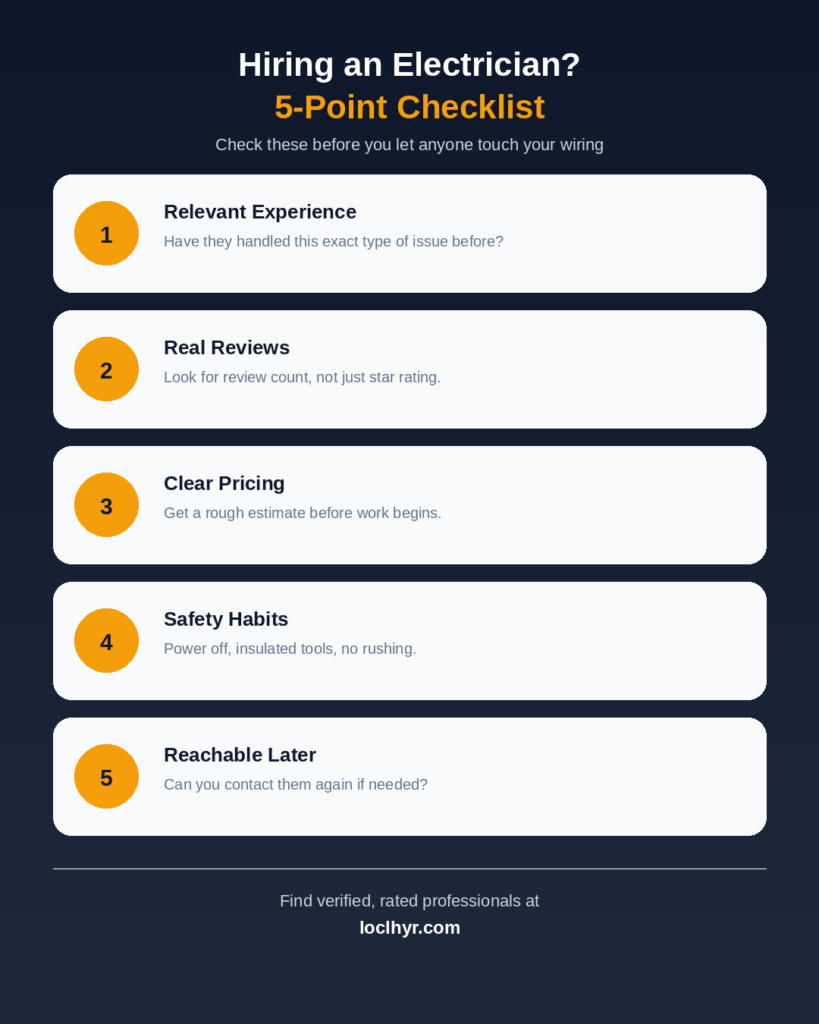
- Have they handled this specific type of issue before?
- Do they have a decent number of genuine reviews, not just a high average?
- Is pricing discussed clearly before work begins?
- Do they follow basic safety practices (turning off power, using proper tools)?
- Can you easily reach them again if the issue isn’t fully resolved?
Frequently Asked Questions
Q: How much does it typically cost to hire an electrician for a small job? It varies a lot by location and the type of work, but most electricians charge either a small fixed visiting/inspection fee plus the cost of the actual repair, or a flat rate for common jobs (like fixing a switch or socket). Always ask for a rough number before work begins.
Q: Should I always ask for a written estimate? For small jobs (a switch, a socket, a fan installation), a verbal estimate is usually fine. For bigger jobs — rewiring, panel upgrades, anything that could run into a significant amount — it’s worth asking for at least a text/WhatsApp message confirming the estimated cost, so there’s a record.
Q: What’s the difference between a “visiting charge” and the actual repair cost? A visiting or inspection charge covers the electrician coming to look at the problem, regardless of whether they end up doing further work. The repair cost is separate and depends on what’s actually wrong. Some electricians waive the visiting charge if you go ahead with the repair — it’s worth asking.
Q: Is it safe to do small electrical fixes myself? Very minor things (like replacing a blown bulb or resetting a tripped switch) are usually fine. Anything involving open wiring, the main fuse board, or persistent tripping should go to a professional — the risk of shock or fire isn’t worth the money saved.
Q: How do I know if an electrician is actually skilled and not just “confident”? Ask specific questions about your exact problem and see how detailed their answer is. Reviews from real customers, and how they discuss safety steps (like turning off the main power first), are usually better signals than how confident someone sounds on a phone call.
Final Thought
Hiring an electrician doesn’t need to be stressful, but it does deserve a few minutes of due diligence. A little bit of checking upfront — experience, reviews, pricing clarity, safety habits, and reachability — can save you from a much bigger headache later.
If you’re looking for verified, rated electricians (or plumbers, carpenters, and other local professionals) in your area, platforms like LoclHyr make it easy to compare ratings and book directly — worth a look next time you need one.